
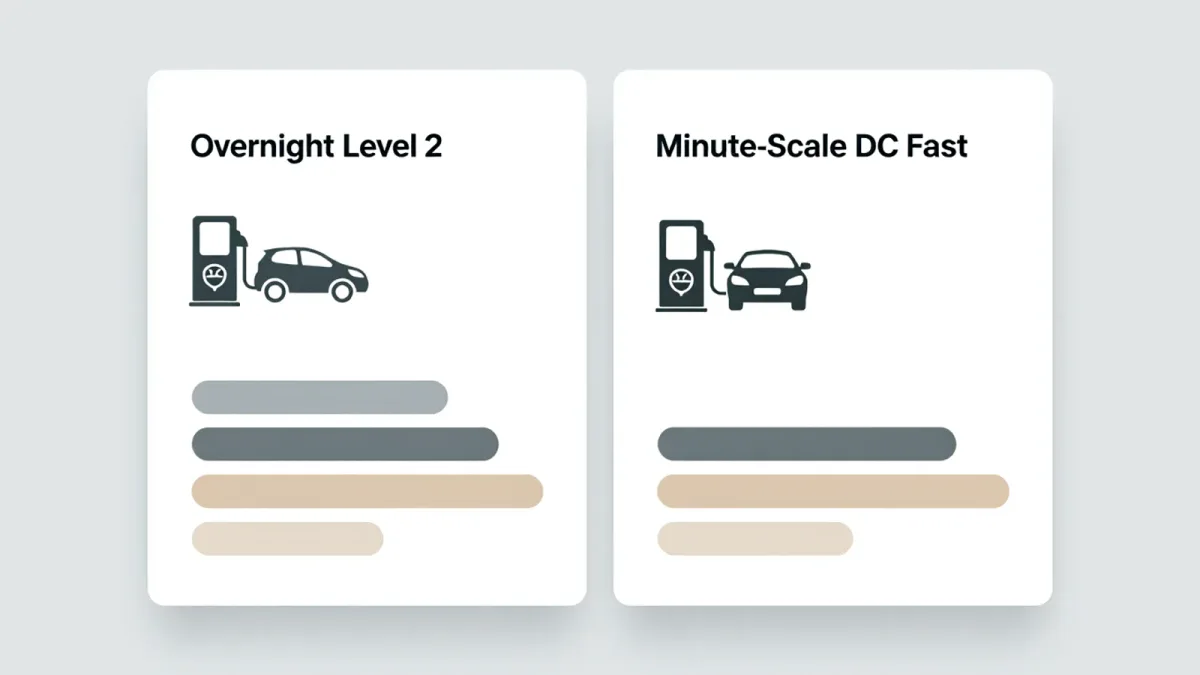
For a hotel, electric-vehicle charging is an overnight-load business. A guest arrives with a depleted battery, parks for eight to ten hours, and needs the car ready by morning — a service profile that Level 2 charging, the slower and cheaper technology, fits almost perfectly. As of 2025, federal infrastructure funding through the National Electric Vehicle Infrastructure program and the IRS Section 30C business credit of up to $100,000 per eligible charger have made installation measurably cheaper, but the economics still depend on one decision made before any hardware is purchased: whether the property is providing a guest amenity or entering the fast-charging business. Per the US Department of Energy's Alternative Fuels Data Center, those are different projects with different customers.
Level 2 or DC fast: which fits a hotel?
Level 2 units charge at roughly 7 to 19 kilowatts, adding double-digit miles of range per hour — more than an overnight stay requires, from hardware and installation typically running a few thousand dollars per port before incentives, depending on trenching and panel capacity. DC fast chargers add hundreds of miles per hour, cost tens of thousands installed per stall, draw utility demand charges that punish idle time, and serve a dwell profile measured in minutes — the traveler stopping for lunch, not the guest asleep upstairs. Highway-adjacent properties with through-traffic can justify fast charging as a retail business; everyone else is buying an amenity.
What does installation actually involve?
The charger is rarely the expensive part. The site work is: distance from the electrical panel to the parking bays, trenching across a lot, panel or transformer upgrades, and — in larger properties — a load-management system that lets several ports share one service feed without tripping the building. Load management is the single most valuable design decision, because it converts a four-port project from a service upgrade into a software configuration. Properties planning phased rollouts should oversize conduit and panel headroom on day one; the marginal cost at construction is small, the retrofit cost is not.
Related stories: Plastic-free amenities: what hotels actually save and spend by ditching miniatures · Local sourcing in hotel F&B: where the story earns its keep and where it costs.
Who pays the guest economics?
Three models operate. Free charging as an amenity, common at select-service properties where the electricity for one guest-overnight costs a few dollars at typical commercial rates. Paid charging through a network operator, where the hotel takes a revenue share or a host fee and the network handles payments, apps, and maintenance. And managed loyalty charging, where sessions are free or discounted for elite tiers — an increasingly common way to attach the amenity to the loyalty program rather than to every parking space. The paid networks' appeal is operational: downtime, support calls, and firmware updates belong to someone else, at the cost of revenue and of guest friction when the network's app fails.
What do the incentives cover?
The Section 30C credit covers a substantial share of qualifying hardware and installation costs per item of charging equipment — up to $100,000 per unit for business property — but only in eligible census tracts, which excludes many suburban and rural properties and makes the eligibility check the first step of any project. Utility programs layer on top: many utilities offer make-ready rebates that cover panel work and wiring. Stacking utility make-ready with 30C where both apply frequently brings a Level 2 project to a fraction of list cost, per US Department of Energy program guidance.
| Option | Typical installed cost per port | Dwell fit | Business model |
|---|---|---|---|
| Level 2, load-managed | Low thousands before incentives | Overnight | Amenity or loyalty perk |
| Level 2, networked paid | Low-to-mid thousands | Overnight | Revenue share with network |
| DC fast | Tens of thousands | Minutes | Retail energy, highway traffic |
For operators, the decision tree is short: overnight guests point to load-managed Level 2; through-traffic points to DC fast or nothing. Properties that buy fast chargers for guests they already have have bought the wrong machine.
The measurement that matters afterwards is utilization: sessions per port per week, and whether charged guests show up in repeat bookings. A quiet charger is a stranded asset; a busy one is a rate justification on the next revenue-management review.