
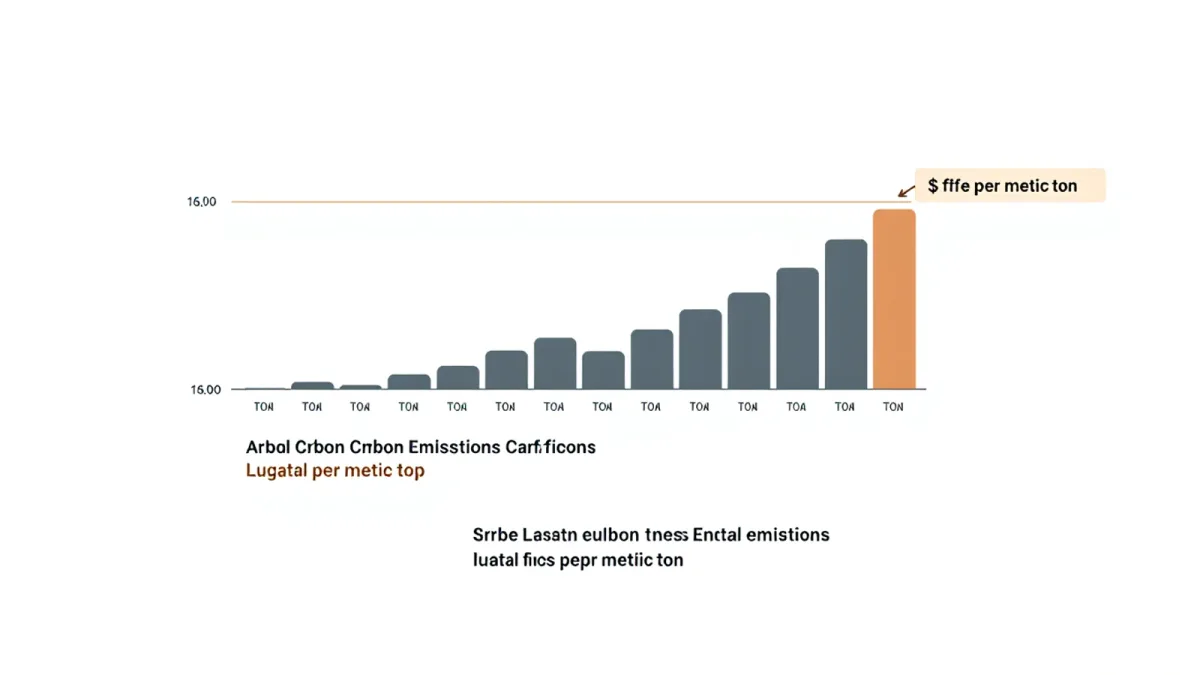
Building performance standards are the regulation that converts hotel energy waste into a named fine. New York City's Local Law 97 caps annual greenhouse-gas emissions for most buildings over 25,000 square feet — roughly 50,000 buildings citywide — and charges $268 per metric ton of CO2-equivalent above the building's limit, per the city Department of Buildings. The first compliance reports, covering calendar 2024, were due May 1, 2025, and hotels sit among the more exposed property types because of their round-the-clock conditioning, kitchens, and laundries. For operators, the law's arithmetic is simple enough for the P&L: every metric ton above the cap is a $268 line item, recurring annually, until the building's systems change.
How does LL97 actually work?
Each covered building receives an annual emissions limit derived from its square footage and its occupancy classification, with hotels in a category reflecting their energy-intensive use. The building reports its actual emissions annually — fuel and electricity converted to CO2-equivalent using city-specified factors — and pays the difference against its cap. The 2024-2029 period sets the first caps at a level most compliant buildings can reach with operational measures; limits tighten sharply in the second period beginning 2030, which is the date that forces plant-level changes rather than tuning. Owners can reduce assessed emissions through purchased renewable electricity and, within limits, renewable energy certificates, and a good-faith pathway exists for buildings making documented progress toward compliance.
The reporting burden itself is modest for a professionally run property — the data is the utility meter data the building already has. The engineering burden is the real one.
Which hotels are most exposed?
The emissions math penalizes specific profiles. Full-service properties with large banquet, kitchen, and laundry loads; older buildings on steam or standard electric resistance heat, whose carbon intensity per square foot runs high; and properties that already deferred HVAC modernization — because the law prices precisely the inefficiency they carry. Select-service and newly built properties, particularly all-electric ones, generally clear the first-period caps with margin. Exposure is also an ownership question: caps attach to the building, so the fine lands on the owner, which means LL97 exposure now appears in valuation, refinancing, and sale diligence for covered New York hotels.
Related stories: Hotel HVAC retrofits: where the energy savings actually come from · CSRD and hotels: who must report after the EU's simplification, and what reaches the rest of the industry.
What does a compliance plan look like?
The sequence mirrors an energy retrofit plan with a deadline attached. First, establish the baseline: twelve months of metered energy, converted per the city's factors, gives the gap to the cap and prices each saving measure at $268 per ton avoided — an unusually concrete internal carbon price for ranking projects. Second, harvest operational and controls measures with one-to-three-year paybacks, which for many hotels closes much of the first-period gap alone. Third, plan the capital measures — electrification of heating, heat recovery, envelope work — against the 2030 caps, with financing sized and begun years ahead, because retrofit timelines and hotel occupancy calendars both resist compression.
Where else do these rules exist?
New York is the largest but no longer alone. Boston's BERDO, Denver's Energize Denver, and Washington, DC's Building Energy Performance Standards each cap or benchmark building emissions or energy intensity with their own fines and timelines, and Washington's standards cover many mid-size buildings that New York's threshold excludes. State-level frameworks, notably Washington State's Clean Buildings law, add performance requirements outside the municipal cluster. For multi-market operators the consequence is strategic rather than administrative: a chain energy standard set to the strictest jurisdiction becomes cheaper than maintaining fifty local compliance programs, and the direction of regulation across major US cities has run one way since 2019.
For operators, LL97 turns the sustainability report into an invoice: the gap between a building's emissions and its cap is priced at $268 a ton, every year, and the 2030 caps double down on the arithmetic.
The compliance calendar matters as much as the caps: annual reports are due each May 1, penalties accrue per reporting year, and the buildings that reported their 2024 year in 2025 now have a documented gap their capital plans can be sized against. The fine is avoidable in a way most new costs are not — it is simply deferred retrofit spending, priced.