
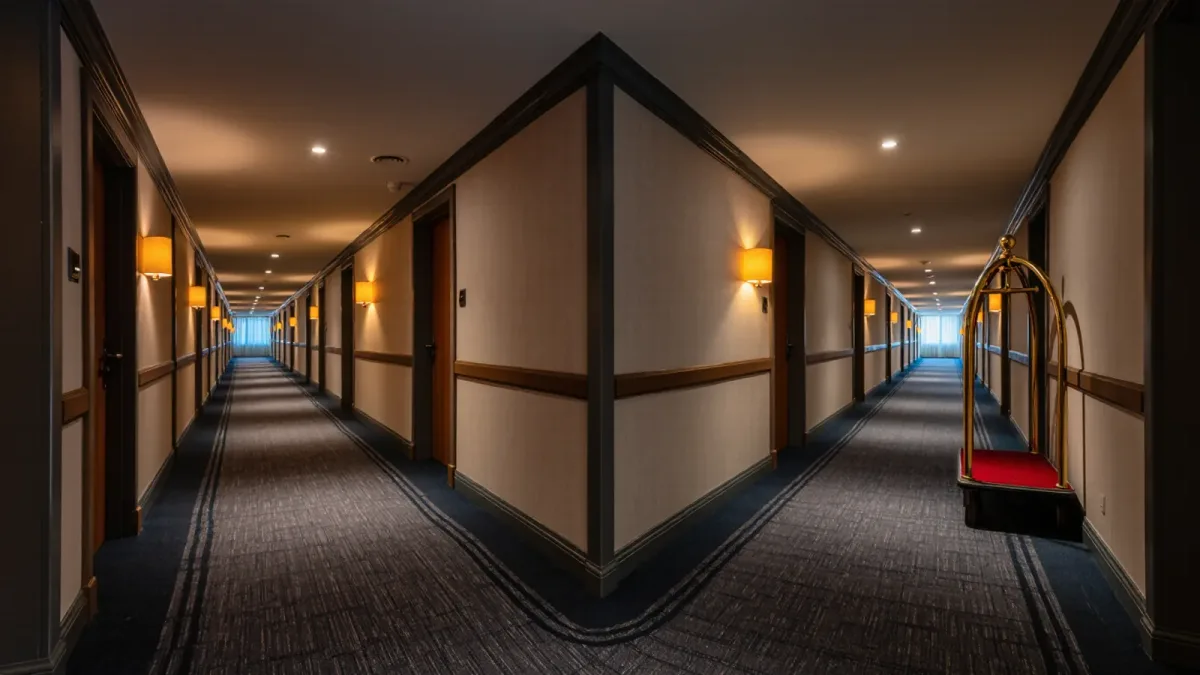
When a guest writes "could hear everything through the wall," the damage is done: noise complaints are among the least recoverable in hotel reviews because the property cannot show the problem was fixed. Sleep quality consistently ranks among the top drivers of guest-room satisfaction in published guest-feedback research, and noise is the most common reason sleep quality fails. Unlike a broken fixture, a noise problem is invisible at check-in, unverifiable at checkout, and remembered longest.
Adults need at least seven hours of sleep per night, per the US Centers for Disease Control and Prevention, and travel disrupts enough of it already — new beds, time zones, unfamiliar light. The hotel's contribution is to stop adding to the deficit.
Where does hotel noise actually come from?
Four channels, in rough order of complaint frequency. Adjacent rooms: voices and television audio leaking through walls and, most often, through the connecting door, whose hollow-core construction transmits sound at levels the masonry around it never will. Corridors: footsteps, luggage wheels, and door slams carried along hard-surfaced corridors directly to every door on the floor. Mechanical: the guestroom's own PTAC or fan-coil compressor cycling, plus rooftop plant transmitted down chases and ducts. Street: traffic, nightlife, and loading docks — usually an upper-floor and street-side problem.
The connecting-door point deserves emphasis for guests choosing rooms: a room with an interior connecting door is measurably quieter-requested-against than a standard room precisely because that door is the weakest acoustic element in the wall assembly.
How can a guest pick a quiet room before arriving?
The levers are concrete. Request a high floor away from elevators, ice machines, and housekeeping closets — the service cores that generate 6 a.m. traffic. Avoid rooms above or below kitchens, ballrooms, and pool decks, and street-facing rooms at the front of the property. Ask whether the room has an interior connecting door and decline it if quiet matters more than flexibility. Properties with room-selection maps in their apps, now common across the major US chains as of 2025, let guests see exactly which rooms border these noise sources — the single most effective quiet-room tool ever put in a guest's hands.
Related stories: Pet-friendly hotel programs: what guests with animals actually get, pay, and must know · Hotel service recovery: what happens after a guest complains, and what actually works.
What does the hotel control in the room itself?
Guests can evaluate the room in the first five minutes. Close the door and listen: door sweeps and automatic seals on corridor doors are the property's best corridor-noise fix, and their absence is audible immediately. Run the HVAC through a full cycle and listen for compressor rattle and duct whistle. White noise machines, heavy blackout drapery with return borders that seal the window edge, and upholstered headboards all damp residual noise — properties that install them have usually heard the complaints first.
What should a guest do when the room is loud?
Call the desk the same night. A first-night complaint gives the property a chance to move the guest before the stay is colored by a second bad night, and most properties will reassign when rooms are available — the constraint is a sold-out floor, not indifference. A noise complaint raised at checkout, by contrast, converts nothing: the night is spent, the room cannot be shown to have been fixed, and the review reads as an ambush. Guests who want compensation rather than resolution should still report in-stay, because documented in-stay complaints are what management companies require before issuing any adjustment.
What actually reduces noise between rooms?
Structurally: mass and decoupling — added drywall layers, resilient channels, insulation in party walls, and solid-core doors with perimeter seals — are the fixes that work, and they arrive only during renovation. Operationally: quiet-hours enforcement, luggage-cart wheel maintenance, staff instruction to close doors rather than let them slam, and placing long-stay or family blocks on floors away from business travelers. None of the operational fixes costs capital, and together they address the corridor and adjacent-room channels where most complaints originate.
For guests, the quiet room is a request made before arrival; for operators, quiet is a maintenance list, not an acoustic engineering project.
Noise is one of the few satisfaction drivers a hotel can improve without touching guest-facing service. The wheel on the luggage cart, the seal on the corridor door, and the room map in the app all matter more than the card in the elevator promising a restful stay.