
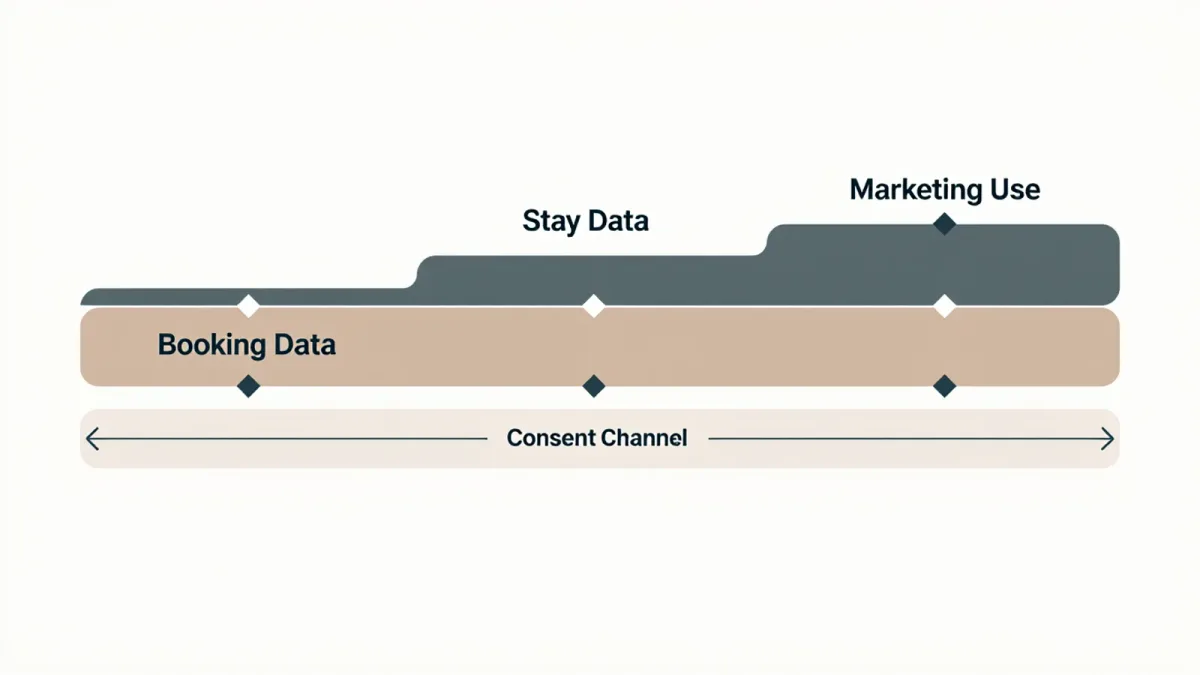
Hotel personalization runs on a guest profile that accumulates across brands and stays: reservation history, room and floor preferences, dietary notes, loyalty tier, payment tokens, complaint and recovery records, and — once the brand's app is on the phone — device and location signals. The trade is real in both directions. The guest whose profile remembers the hypoallergenic pillow, the high floor away from elevators, and the late checkout gets a better stay with less repeating of themselves. The guest who never read the privacy notice has joined a data relationship whose scale most travelers underestimate. As of 2025, US privacy law is a patchwork of state statutes, and the Federal Trade Commission's privacy and security guidance sets the enforcement backdrop the hospitality industry's data practices operate under.
What does a hotel actually know about a guest?
The profile begins before the stay: booking channel, rate, dates, party composition, and any requests entered in text fields. At the property it accretes: folio detail — which reveals minibar, spa, and restaurant behavior — keys issued, service tickets, complaints, and compensation granted. Around the stay sit the app layer, where the major chains' membership programs number their enrollment in the hundreds of millions, and the marketing layer of email engagement and browsing signals. Third-party bookings contribute less: the OTA holds the customer relationship, and many properties receive only the guest name and channel, which is precisely why brands push direct booking so hard — the data as much as the commission.
What do hotels do with it?
Three uses dominate. Operations: preference fields drive room assignment and housekeeping notes, which is where personalization pays for itself in satisfied-repeat-guest terms. Marketing: segmentation, offers, and the algorithmic pricing messages that greet returning guests. And monetization: aggregated and pseudonymized data sharing with partners — airlines in loyalty coalitions, payment networks, advertising platforms — under the terms of the privacy notice most guests accepted without reading.
Guests can steer this at three control points. The privacy notice states what is collected and shared; the marketing-consent toggles govern the outbound channel; and in jurisdictions with comprehensive privacy statutes, guests hold rights to access and delete their data, exercisable through the brand's privacy office.
Related stories: Duty of care in hotels: what operators owe guests, staff and the liability ledger · OTA commissions: what a booking really costs once the invoice is totalled.
Where does personalization genuinely serve the guest?
The high-value uses are the visible ones: remembered preferences that remove repeated requests, service-recovery history that prevents a guest from re-explaining a problem to a new shift, dietary flags that reach the kitchen before the banquet does, and app-based controls over room selection and key distribution. The common thread is consent-plus-benefit: the guest supplied the data to improve their own stay, sees the improvement, and can correct it. Personalization earns trust in exactly the same way service recovery does — by closing the loop visibly.
Where does the line sit?
The uncomfortable territory has recognizable markers. Inference beyond the stay: health or relationship inferences drawn from folio patterns and sold or applied in marketing cross a line guests react to strongly. Surveillance creep: WiFi tracking of device movement around the property, cameras in corridors feeding analytics, and room-occupancy sensing all run into the expectation that a guestroom is private territory — occupancy sensors installed for energy savings have generated guest pushback precisely because the sensing can feel like monitoring. Data breadth without security: a hospitality brand holding hundreds of millions of profiles is an attractive breach target, and the industry's major incidents have made guests appropriately skeptical of retention policies that never expire anything.
For guests, the working rule is simple: data given for the stay should serve the stay, and anything broader deserves a read of the privacy notice. For operators, the same rule is the strategy — visible benefit now beats invisible monetization later.
The properties that navigate this well publish plainly what they keep, honor deletion requests without friction, and confine personalization to the places guests can see it working. That discipline is becoming harder to avoid anyway: state privacy statutes keep widening the set of guests with legal rights over their profiles, and the cost of an enforcement action or a breach announcement dwarfs the value of the data practice that invited it.