
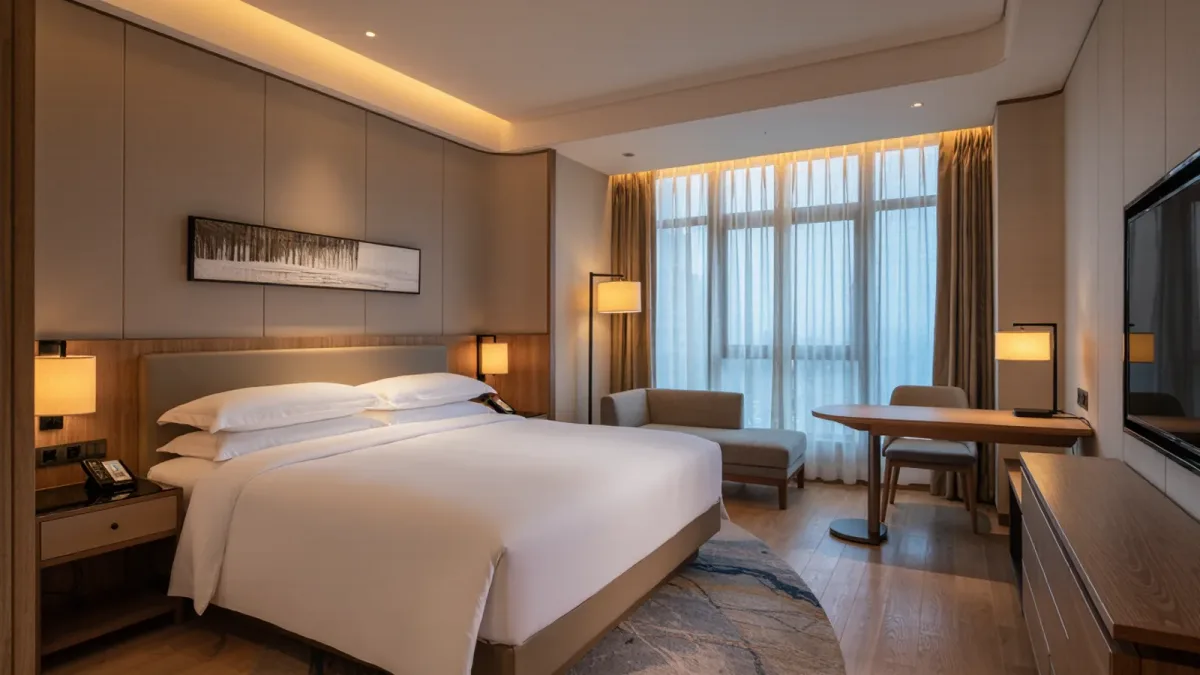
Layered lighting is the specification of a room in multiple light sources at different heights and color temperatures — ambient, task and accent — each switchable independently, instead of one central fixture doing every job. In guest rooms it has become standard practice because the room is a multi-use space: office by day, dressing room by evening, reading nook and sleep environment by night.
The design logic, and the operating economics behind it, are straightforward once the tasks are listed.
What are the layers in a guest room?
Three layers, in specification order. Ambient light — the general illumination, best kept low-level and indirect: cove lighting, wall washes, shaded lamps. Task light — reading lamps at the bed, a desk lamp at the work surface, vanity lighting at the mirror bright enough for grooming. Accent light — directed beams on art, headboard details and textured walls, which is where much of the perceived luxury in a room actually comes from.
The single most common guest complaint in poorly lit rooms is the reverse of what designers assume: not too dark, but one too-bright ceiling fixture with no intermediate settings — flattering for cleaning, hostile to everything else.
Related stories: The most expensive square meters: bathroom design, water fixtures and cost in use · Transforming hotel rooms: flexible design that sells one room as three configurations.
What does color temperature do?
Color temperature, measured in kelvins, decides whether a room reads as clinical or restful. Warm light, around 2700K, suits bedrooms and evening; cooler light, 3000-4000K, suits task areas and bathrooms where accurate grooming matters. The current specification conversation is about tunable fixtures that shift warmer through the evening — a nod to circadian research on light and sleep, including work published by US government research agencies on how evening light exposure affects sleep quality. Operators should treat vendor circadian claims as claims; the durable part of the evidence is that bright, cool light late at night works against sleep, which is enough to justify warmer evening scenes.
The practical spec: warm ambient defaults, cooler dedicated task and vanity circuits, and scene controls so the guest does not have to think about it.
What does layered lighting cost — and save?
Layered schemes cost more in fixtures and controls than a single fixture, but the operating ledger has moved in their favor. LED conversion cut lighting energy use dramatically — the US Department of Energy estimates residential LEDs use at least 75% less energy than incandescent lighting and last far longer, and commercial fixtures track the same physics — so running multiple low-draw circuits is cheaper than running one bright legacy circuit. Dimming extends further: scenes at low output draw less and age lamps slower.
Maintenance is the quiet line: fewer lamp-change work orders per room per year, since long-life fixtures turn lighting from a recurring engineering task into a renovation-cycle item.
Guest room lighting is task design. Specify for the room's actual hours — work, grooming, reading, sleep — and the perceived quality of the room rises for the cost of fixtures that now run cheaper than the ones they replace.