
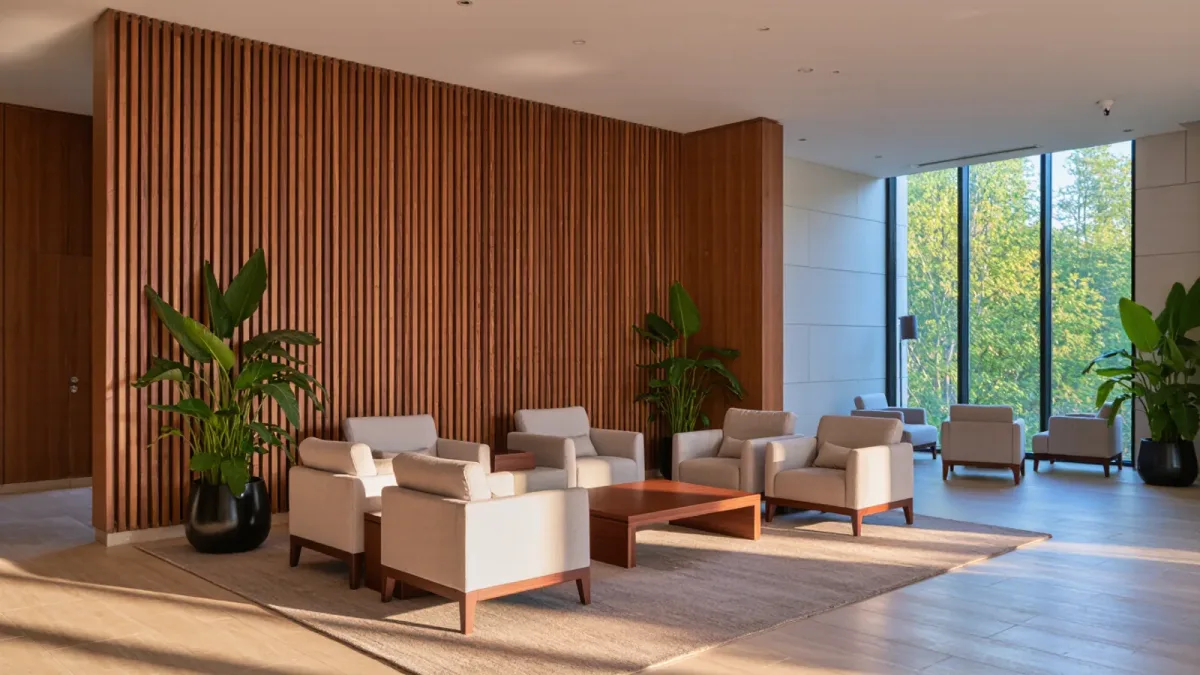
Biophilic design is the practice of incorporating natural elements — plants, daylight, water, natural materials and views of nature — into built interiors. In hotels it ranges from potted greenery and timber surfaces to planted living walls and full atria, supported by a body of environmental psychology research associating natural interiors with reduced stress and higher perceived quality of space.
For operators the question is commercial: does the biophilic premium survive contact with its maintenance budget?
What counts as biophilic — and what does each tier cost?
The practical tiers differ sharply in cost behavior. Direct nature — living plants, green walls, water features — buys maximum visual impact and maximum upkeep: irrigation, lighting calibrated for plant health, replacement cycles and specialist care. Indirect nature — timber, stone, rattan, wool, nature imagery, organic forms — delivers much of the perceived effect in furniture and finish choices with essentially no incremental operating cost. Spatial biophilia — daylight access, views out, natural ventilation, varied sightlines — costs design attention and window discipline rather than maintenance.
The budget-efficient projects weight the portfolio toward indirect and spatial biophilia and deploy direct greenery where guests linger: arrival, bar, corridors to meeting space.
Related stories: Hotel acoustics: the design discipline guests never praise but always review · The most expensive square meters: bathroom design, water fixtures and cost in use.
What does the evidence actually support?
Environmental psychology studies, including work reviewed by US Forest Service researchers and university groups, associate exposure to interior greenery and daylight with lower measured stress and higher self-reported satisfaction. What the evidence does not establish is a precise ADR premium attributable to a green wall; operators should treat wellbeing claims from biophilic design vendors as claims, and test them against their own guest satisfaction scores and rate realization.
Where the effect is commercially clearest is in photography and perceived value: naturally lit, planted interiors outperform their commodity equivalents in guest-generated images and first impressions, which feeds the direct booking channel.
What are the operating realities?
Living walls are mechanical systems: irrigation lines, grow lighting, drainage and a service contract, with full-replacement risk if maintenance lapses. Potted schemes are cheaper but still carry watering, pest control and rotation. Operators adopting direct biophilia should budget the care explicitly — a dying green wall reads worse than no green wall — and locate water features away from rooms where sound carries at night.
There is also a sustainability crossover: sourcing certified timber and natural materials, and passive daylighting, align with the environmental reporting many ownership groups now require. Design choices made for guest perception can double as ESG line items, provided the sourcing claims are documented rather than asserted.
Biophilia earns its place when treated as a tiered toolkit rather than a slogan: heavy on daylight, materials and views, selective with living systems, and honest about who waters the plants.